Choosing scissors
Scissor Handle Types Explained
A scissor's handle shape is defined by the length and angle of the thumb-side and ring-finger-side handles (shanks). A classic handle is symmetrical, an offset handle has a shorter thumb-side handle, and a crane handle is an offset handle with an angle on the ring-finger side.
Key points
- A classic handle is symmetrical, with thumb-side and ring-finger-side handles of almost the same length.
- An offset handle has a thumb-side handle (shank) that is shorter than the ring-finger side.
- A crane handle is an offset handle with the ring-finger-side handle angled downwards.
How a handle is made
A scissor handle is made up of the shank, the arm that runs from the pivot to the finger ring, and the ring you put your finger into. The ring for your thumb is the thumb ring, and the ring for your ring finger is the finger ring. The thumb-side blade is the moving blade and the ring-finger-side blade is the still blade: when cutting, it is mainly the thumb that moves, while the ring-finger side supports the scissors.
The differences in length and angle between the thumb-side and ring-finger-side handles (shanks) are what make the different handle shapes.
Finger rest
Many models have a finger rest beside the finger ring for your little finger. Resting your little finger on it steadies the point where you support the scissors. If it is removable, you can fit it or take it off to suit your hold.
Ring size and inserts
Some models let you adjust the size of the rings by fitting a rubber or plastic insert inside them. If a ring is too big, the scissors move around on your finger every time you open and close them. Using an insert to fit the ring to your finger steadies your hold.
Classic (symmetrical)
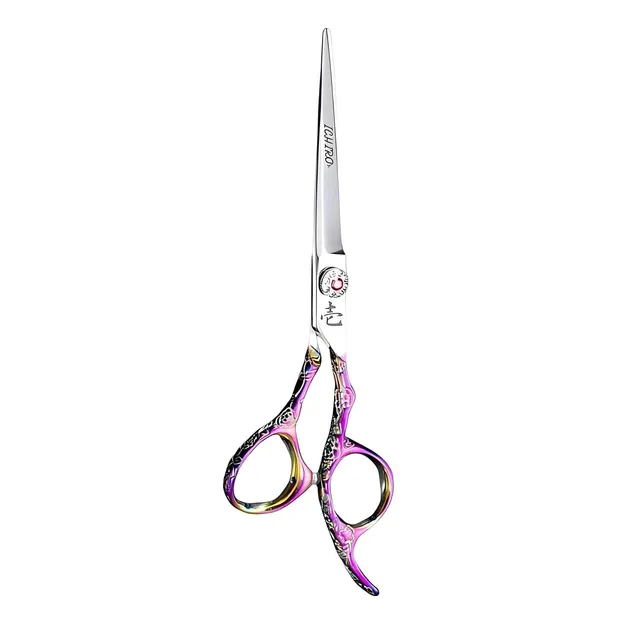
A handle whose thumb-side and ring-finger-side handles (shanks) are almost the same length, so it looks symmetrical, like a pair of glasses, when opened. It is also called a regular or straight handle, or an opposing grip.
- The thumb and ring finger move at the same height.
- It is often used in hairdressing school classes when learning the basic hold.
- It suits cutting with the thumb inserted deeper and a firm grip.
Among the models we carry, the Ichiro Amethyst Cutting Scissors and the Juntetsu Crystal Elite Classic Cutting Scissors have a classic handle.
Offset
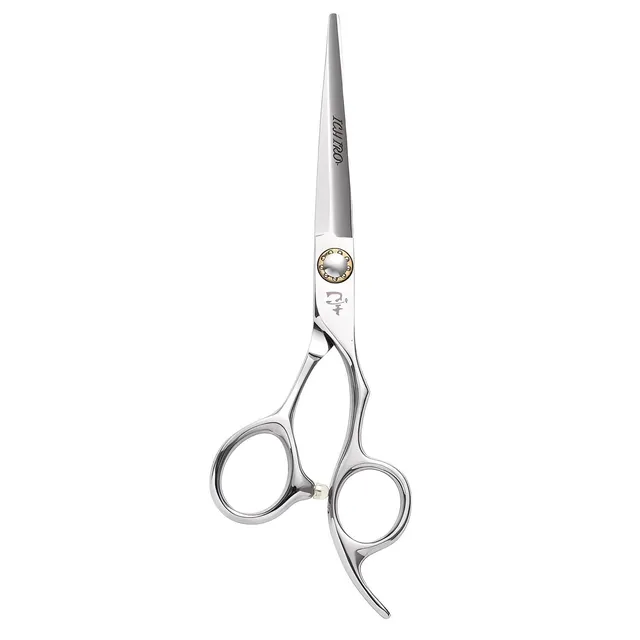
A handle whose thumb-side handle (shank) is shorter than the ring-finger side, so the thumb ring sits closer to the pivot than the finger ring. Most professional scissors today use this shape.
- The thumb ring sits nearer the pivot than the finger ring, so the two rings are staggered.
- The usual hold is with the thumb inserted shallowly, to around the first joint.
- It is widely used in salon work, and is an easy handle to compare when choosing professional scissors for the first time.
Semi-offset
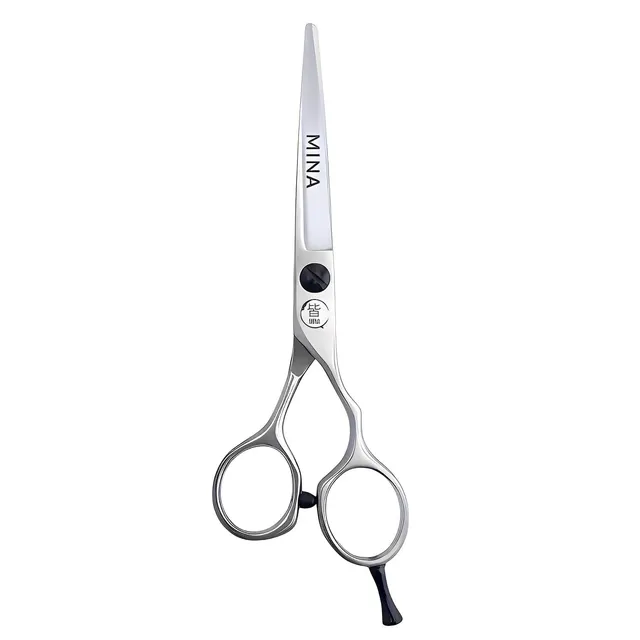
The shape halfway between classic and offset is called semi-offset. The thumb-side handle (shank) is just slightly shorter than the ring-finger side, which makes it an easy shape to compare when moving to an offset handle after training on a classic one. The Mina Classic II Cutting Scissors are a semi-offset model.
Crane
A shape that takes the offset further, with the ring-finger-side handle angled downwards. Seen from the side, it looks like a crane stretching out its neck, which is where the name comes from.
- As with an offset handle, the thumb-side handle is short, and the ring-finger-side handle bends downwards near the pivot.
- The blade and handle are not in a straight line, so the scissors look different in the hand from other shapes.
- Until you are used to the shape, practising the hold can take a little time.
The models we carry are mostly offset, and we don’t currently carry any crane handle models.
Swivel thumb (rotating thumb ring)
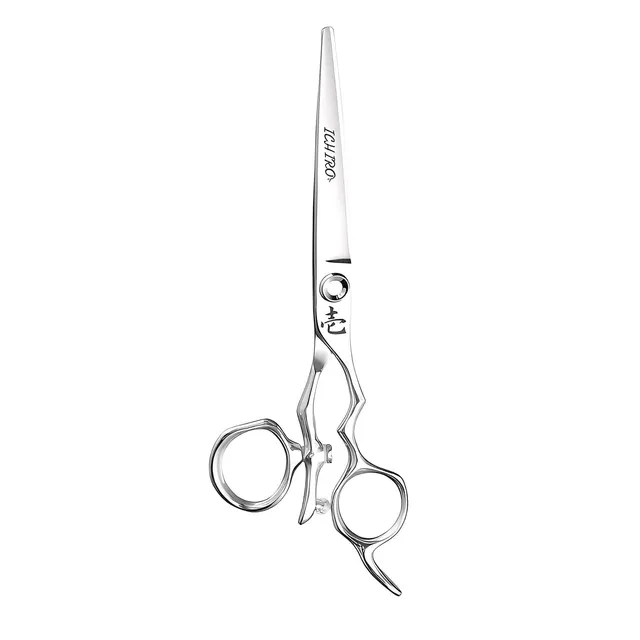
A thumb ring that rotates around a pivot is called a swivel thumb. The angle of the ring changes to follow the direction of your thumb, so you don’t need to change the direction of your thumb when you hold the scissors at different angles.
- Offset swivel: an offset handle with a rotating thumb ring. The Ichiro Kawa Z-Balance Swivel Thumb Cutting Scissors have this shape.
- Double swivel: a thumb ring that rotates at two points. The Mina Sakura Double Swivel Cutting Scissors have this shape.
With a swivel thumb, the way your thumb moves feels different from a standard handle. When you first use one, check your hold on cuts you are already comfortable with.
Telling the shapes apart
You can tell handle shapes apart by looking at the closed scissors from the side.
| Handle | Thumb-side handle (shank) | Ring-finger-side handle (shank) |
|---|---|---|
| Classic | Almost the same length as the ring-finger side | Almost the same length as the thumb side |
| Offset | Shorter than the ring-finger side | Longer than the thumb side |
| Crane | Shorter than the ring-finger side | Long, and angled downwards |
In salon work you hold the scissors at many angles: with the blades horizontal, vertical and more. Try holding them in the positions you cut most (around the ears, at the nape, on the top and so on) and compare which shapes are easy to hold, and you will see which shape suits you.
How to insert your thumb
How deep you put your thumb into the ring matters as much as the handle shape.
- Fingertip to the first joint: makes fine control of the tip easier. Often used with offset and crane handles.
- To the second joint: gives a firm grip, but your thumb movements become larger. Often used with classic handles.
The basic hold is with the ring finger inserted to somewhere between the first and second joints, and the little finger on the finger rest. Choosing a handle to suit the way you normally insert your fingers makes switching between scissors feel more natural.
How to try them
The surest way to check a handle shape is to hold the scissors in position. If you can hold them, check in this order.
- Insert your thumb and ring finger, and rest your little finger on the finger rest.
- With the blades horizontal, hold them at eye height, chest height and waist height.
- Move only your thumb, and check that you can open and close with a small movement.
- Check that you can hold them in the same way with the blades vertical too.
If you are buying online, take the handle shape of the scissors you use now as your reference, and choose the same shape or one that is only one step different (classic to semi-offset, offset to crane and so on). This keeps the difference small when you switch.
Side by side
| Handle | Shape | Typical use |
|---|---|---|
| Classic | Symmetrical | Practising the basics, cutting with a firm grip |
| Semi-offset | Thumb-side handle slightly shorter | Moving on from a classic handle |
| Offset | Thumb-side handle shorter | All-round salon work |
| Crane | Offset with a downward angle on the ring-finger side | Anyone wanting a change from offset |
| Swivel thumb | Thumb ring rotates | Anyone who holds scissors at many angles |
If you can’t decide, try an offset handle first, then compare classic and crane handles against your hold. How to choose a size is covered in “How to Choose Your Scissor Size”, and for left-handed stylists, see “Scissors for Left-Handed Hairdressers”.
Changing handle shape
When you change to a different handle shape, the way your thumb moves and the feel of your hold change at first. After switching, getting used to them in this order makes the differences easier to check.
- Hold them in front of a mirror and check your hold with the blades horizontal and vertical.
- Start using them on a mannequin head, or on cuts where they will have little effect on the finish.
- Alternate with your previous scissors and compare how you place the tip.
Changing one step at a time, from classic to offset and from offset to crane, makes the difference in hold easier to get used to.
Summary
- The handle shape is defined by the length and angle of the thumb-side and ring-finger-side handles (shanks).
- Classic handles are used for practising the basics and offset handles widely for all-round salon work, while a crane handle is an offset handle with an angle on the ring-finger side.
- Choose by trying the depth you insert your thumb and the positions you normally hold your scissors in.
To browse by handle shape, filter the “Cutting Scissors” list by handle type.
The models in this guide
| Model | Sizes | Handle | Edge | Hand | Price (tax-free) |
|---|---|---|---|---|---|
| Ichiro Amethyst Cutting Scissors | 5.5–6.5″ | Classic (even) | Convex | Right-handed | ¥24,545 |
| Ichiro Offset Cutting Scissors | 5.0–7.0″ | Offset | Convex | Right-handed | ¥22,909 |
| Mina Classic II Cutting Scissors | 5.0–6.0″ | Semi-offset | Micro-serrated | Right-handed | ¥11,364 |
| Ichiro Kawa Z-Balance Swivel Thumb Cutting Scissors | 5.5–6.5″ | Offset swivel | Convex | Right-handed | ¥25,636 |
| Mina Sakura Double Swivel Cutting Scissors | 5.5–6.5″ | Double swivel | Convex | Right-handed | ¥15,182 |
| Juntetsu Crystal Elite Classic Cutting Scissors | 5.0–6.0″ | Classic (even) | Convex | Right-handed | ¥29,182 |