Care and sharpening
How to Adjust Scissor Tension
Tension is how tightly the pivot screw holds the two blades together. As a guide, with the tip pointing up, open the thumb-side blade and let go. The blade should stop with the tip slightly open. Too loose or too tight, and hair won't cut cleanly.
Key points
- If the tension is loose, hair folds between the blades, and if it is tight, the action is heavy and the inner faces of the blades wear faster.
- Check it by pointing the tip up, opening the thumb-side blade and watching where it stops when you let go.
- Check what type of adjustment screw you have, then turn it a little at a time and test cut each time. If the screw won't turn or there is an unusual noise, send them for a check-up.
What tension is
Scissors are two blades held together by a pivot screw, built so that the blades press slightly against each other. How firmly they press is called the tension. The tension changes with how tight the screw is.
When the tension is right, the blades open and close lightly, and as they close they stay in firm contact and cut the hair. Tension changes gradually with care and use, so it needs checking regularly.
Signs that it is too loose or too tight
| State | Typical signs |
|---|---|
| Too loose | Hair folds between the blades, hair escapes at the tip, the blades wobble as they open and close, the tips don’t line up when closed |
| Too tight | The action is heavy, you have to push with your thumb, the blades make a rubbing sound, the blades don’t glide easily when slide cutting |
| Right | The blades open and close lightly, and hair cuts cleanly right to the tip |
If you carry on using them loose, the tips can knock together and chip. If you carry on using them too tight, the inner faces of the blades rub together and the condition of the edge changes more easily. Either way, reset the tension promptly.
How to check
Check the tension with these steps. Wipe off clippings and oil first.
- Hold the ring-finger-side handle and stand the scissors upright with the tip pointing up.
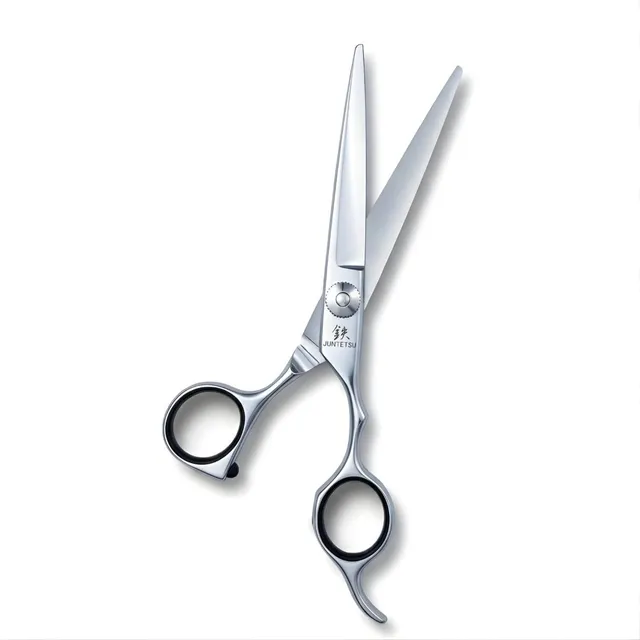
- Lift the thumb-side handle to open the blades wide.
- Let go of the thumb-side handle.
- Watch the blade close under its own weight.
If the blades don’t close fully and stop with the tip slightly open, that is a guide to standard tension.
- They close all the way: the tension is loose.
- They barely move, or stop straight away: the tension is tight.
Also cut a fine section from the tip to the heel, and check that the hair cuts cleanly at every point along the blade. Depending on how they like to cut, some stylists set it slightly firmer or slightly lighter. If you remember the setting that suits your everyday work, you will notice changes more easily.
Types of adjustment screw
The screw that adjusts tension differs in form from model to model.
- Screwdriver screw: the screw head has a slot, and you turn it with a flat-head screwdriver or similar.
- Dial: a dial you can turn with your finger or a coin. Some click round in steps.
- Special tool: you turn it with the special tool (key) supplied.
- No adjustment screw: the screw is fixed, and you can’t adjust it yourself.
Which way tightens and which way loosens can differ by model. Check the instructions supplied before turning it.
Points to watch when adjusting it yourself
- Turn it a little at a time: don’t turn it a lot in one go; check after each small turn.
- Test cut after turning: repeat the checking steps and a test cut on a fine section.
- Turn it with the blades open: turning it with the blades closed can make the tips knock together.
- Remember the setting that suits you: remember the position on the scale for a dial, or the direction of the slot for a screw, as a reference for next time.
After adjusting, put one drop of oil on the pivot and open and close a few times to work it in.
When to leave it to a professional
In cases like these, don’t adjust them yourself: send them for a check-up.
- The screw is too stiff to turn, or turning it doesn’t change the tension
- A model without an adjustment screw feels heavy or loose
- Since being dropped, the blades knock together or the tips don’t line up when closed
- There is an unusual noise or a catch as they open and close
- Even with the tension reset, hair folds between the blades
If they still cut poorly after resetting the tension, the edge may have rounded. The signs that resharpening is due are covered in “When to Get Your Scissors Sharpened”.
What makes tension change
Tension isn’t something that stays put once set. It changes gradually for reasons like these.
- Repeated opening and closing: everyday use can gradually loosen the pivot screw.
- Drops and knocks: an impact can shift the screw or bend a blade very slightly.
- Not enough care: when clippings and dirt build up at the pivot, the action becomes heavy and the tension feels tighter.
- After resharpening: once the blades have been restored, the tension may need resetting.
If the action feels heavy, wipe the clippings from around the pivot and oil it before turning the screw. If dirt is the cause, that alone may make it lighter.
Tension and the cutting you do
Even with the same scissors, the tension that is easiest to work with differs a little with the cutting you do most.
| Type of cutting | Suggested tension | Why |
|---|---|---|
| Blunt cutting, wet cutting | Slightly firm | The blades stay stable even on a gathered section |
| Slide cutting | Medium | The blades glide lightly and move easily over the hair |
| Dry cutting | Standard | Makes small, repeated opening and closing easier |
| Thinning | Standard | The blades close fully and the hair between the teeth is cut evenly |
If one pair does many kinds of cutting, start from standard tension and adjust slightly only when something bothers you.
Tension on Thinning Scissors
Thinning Scissors are checked in the same way as Cutting Scissors. If the tension on Thinning Scissors is loose, hair folds between the teeth and is more likely to be left uncut. If the weight you remove is uneven, or going into the same place doesn’t take out any more, check the tension.
Scissors with a swivel thumb
Swivel thumb scissors, whose thumb ring rotates, also have a mechanism in the rotating part. The tension is checked in the same way, but don’t remove or tighten the screws and parts of the rotating section yourself. If the rotation is stiff or wobbles, send them for a check-up.
Tension on newly delivered scissors
When new scissors arrive, check the tension before you start using them. Vibration and temperature changes in transit can change how the tension feels. Watch where the blade stops using the checking steps, and test cut a fine section before you start using them.
Before your first test cut, hold them and check the size of the finger rings and the length. For the terms that apply to your order, see the trade terms or contact us.
Do I need to reset it every day?
You don’t need to turn the screw every day. Once or twice a week, watch where the blade stops using the checking steps, and reset it only when something has changed. Turning it too often can leave you unsure where the right setting is.
Summary
- Check the tension by pointing the tip up, opening the thumb-side blade and watching where it stops when you let go.
- Check what type of adjustment screw you have, then turn it a little at a time and test cut each time.
- If the screw won’t turn, or the blades are out of line after a drop, send them for a check-up.
The daily care routine is set out in “How to Care for Your Scissors”.